Updated August 2026
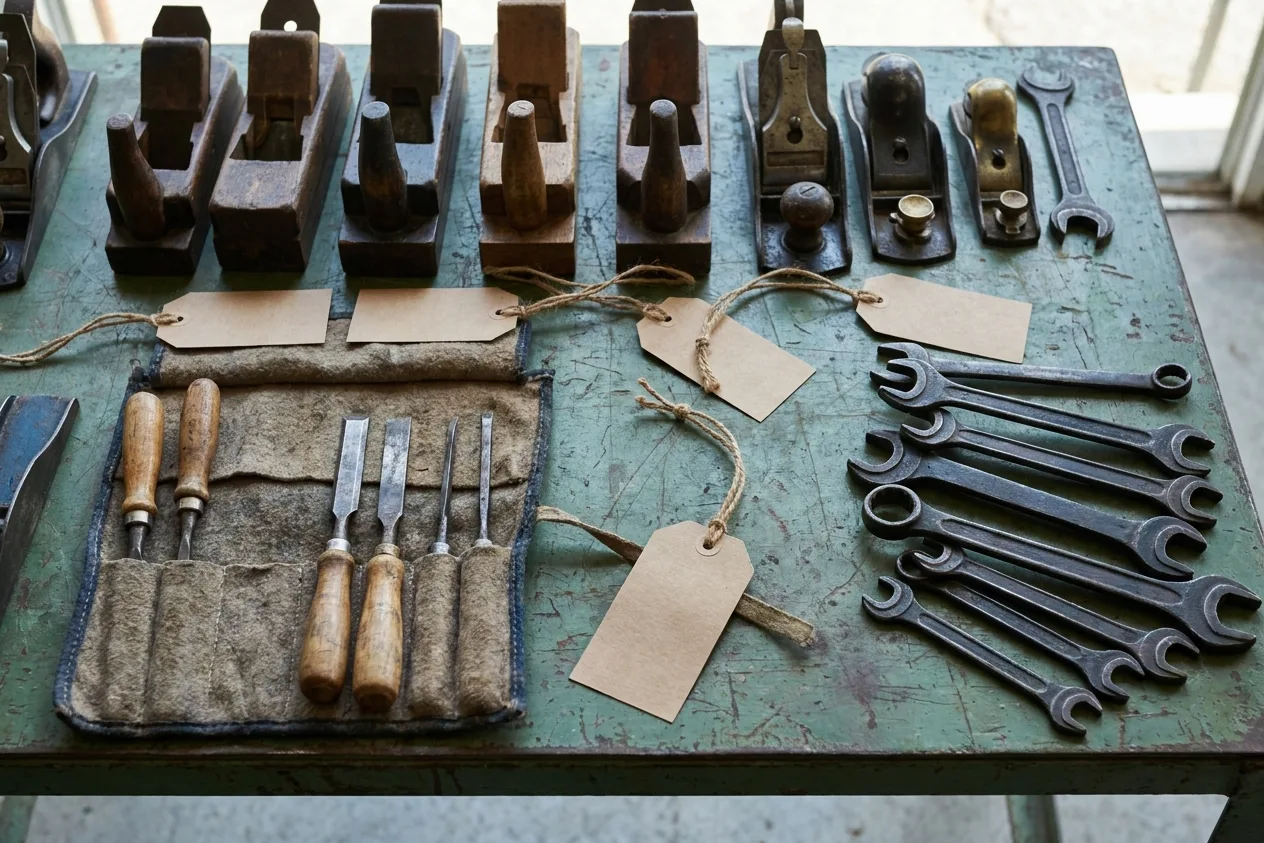
How to price vintage tools at an estate sale
A basement workshop is one of the few rooms in an estate where a serious buyer will drive two hours and arrive before you open. Tool people are knowledgeable, they know exactly what they are looking for, and they will find it in your pegboard jumble in about four minutes. That is good news for the family, because demand is real, and it is a warning for you, because a shelf priced carelessly gets picked clean by the people who knew better.
Blue Moon Estate Sales’ 2026 outlook lists vintage hand tools and professional-grade workshop equipment among the categories that remain consistent sellers. The category is not soft. It just requires that you know which twenty items on a wall of two hundred are the ones that matter.
The shape of the room
Most workshops break down the same way, and the piles are worth making before you price anything.
- Collectible hand tools. Planes, chisels, braces, levels, saws, and anything by a maker with a following. This is where the value concentrates.
- Machinist and measuring tools. Micrometers, dial indicators, surface gauges, combination squares. Precision instruments, judged on accuracy and condition.
- Working power tools. Priced on whether they run and how good they were when new.
- Everything else. Fasteners, offcuts, half-used consumables, the third hammer. Bulk.
Do the first two slowly. Do the last two fast. The mistake is spreading effort evenly across a room where the value is not distributed evenly at all.
Reading a hand plane, which is the skill worth having
If you learn one thing about tools, learn planes. They are the most collected category, they turn up in nearly every workshop, and the number cast into the body tells you most of what you need.
Patrick Leach’s Blood and Gore, the reference the tool-collecting world actually uses, lists the Stanley Bailey bench-plane series by size: No. 1 at 5.5 inches long, No. 2 at 7, No. 3 at 8, No. 4 at 9, No. 5 at 14, No. 6 at 18, No. 7 at 22, and No. 8 at 24.
The rank order of desirability is roughly the inverse of how many were made, and the reference is blunt about both ends. Of the No. 1: “Every serious collector of old tools wants one of these little monkeys, which makes the cost of owning one rather steep.” The No. 2 it describes as “certainly scarce (when compared to the larger bench planes)”, because its use was limited. At the other end, it says of the No. 4 and No. 5 that those two “made Stanley a fortune”, which is a polite way of saying there are an enormous number of them in circulation. The No. 5 it calls “the most useful of all the bench planes”. Among the variants, it singles out the No. 5 1/4C as “the scarcest plane of the entire Bailey series”.
So the working rule when you find a stack of planes: read the number, and let small numbers slow you down. A No. 4 is a good tool and an ordinary object. A No. 1 or No. 2 is worth stopping the pass for.
Leach’s reference deliberately does not publish prices, and this page will not invent them. What it gives you is the thing an operator actually needs, which is a reason to look twice at the right pieces. Price the number itself against recent sold results, the same way the pricing chapter of our free playbook treats every research-worthy item.
Beyond planes: what else earns a second look
- Named makers. Certain names carry a following well beyond the tool’s utility. If a chisel, level or brace has a maker’s name stamped into it, that name is worth a search before it goes in a bin.
- Complete boxed sets. A machinist’s set with its original case, all its accessories and its certificate is worth substantially more than the same tools loose. Do not break sets up.
- Wooden molding planes. Often sold by the armful for a few dollars each. Complete matched sets, and unusual profiles, are not that.
- Anything with a patent date. A cast patent date makes a tool researchable, and researchable means priceable.
- Trade-specific tools. Coopering, wheelwrighting, saddlery and other vanished trades have small but committed collector bases.
Do not clean it, and do not paint it
This is the trap that costs the most money in this category, and it looks like helpfulness.
Light surface rust can be wiped back with oil and a rag. That is the whole of the permitted intervention. A wire wheel, an abrasive blast cabinet or a coat of fresh paint strips the original japanning, the plating and, worst of all, the maker’s markings and the faint blade logos that date a tool. Collectors are buying originality. A cleaned tool has less of it than a dirty one, and the process does not reverse.
On measuring tools the damage is functional as well as historical. Polishing a ground reference surface on a square or a straightedge changes it, and a machinist can tell. Leave the patina, leave the graduations, and let the buyer decide what to do.
The family will offer to help by tidying the workshop. That offer needs to be intercepted during the walkthrough, kindly and early.
Clearing the ordinary volume
The rest of the room is a logistics exercise.
Group by kind, not by value. Trays of screwdrivers, trays of wrenches, trays of pliers, each tray one price. Buyers dig, and digging is part of the fun for this audience.
Price power tools individually and honestly. State whether it runs. A buyer will plug it in, so there is no version of this where an optimistic description survives the morning.
Bulk the consumables. Boxes of fasteners, sandpaper, offcuts and hardware sell by the box or the coffee can and are not worth sorting.
Put the heavy machines out early with real prices. A table saw or a lathe needs a buyer with a truck and two friends, and that buyer needs to see it advertised before the sale rather than discovered on Saturday. Getting the right people to arrive at the right time is what running sale days is about, and it matters here more than in most rooms.
Where operator knowledge in this category comes from
Tools are one of the few categories with an active, welcoming and genuinely scholarly collector infrastructure, and it is worth plugging into if this keeps coming up in your houses.
The Mid-West Tool Collectors Association describes its purpose as promoting “the preservation and study of antique and traditional tools, implements, and devices of the trades, the shop and the farm”. It publishes The Gristmill quarterly, holds regional and national meetings where tools change hands, and maintains a member directory specifically so members can locate experts on particular tools. The Early American Industries Association, which has run for more than ninety years, “preserves and presents historic trades, crafts, and tools”, publishes The Chronicle quarterly along with a members’ newsletter, and offers members access to a network of knowledgeable collectors and museum professionals.
Either one gets you further, faster, than any amount of solitary searching, and a phone call to somebody who has collected one maker for thirty years is worth more than an afternoon of your own research. Building that short list of people to call is the same discipline the playbook recommends for every specialist category.
When to slow down or call
Slow down for a workshop that has clearly been collected rather than accumulated: tools displayed rather than stored, matched sets, duplicates of the same model in different types. Call somebody for a large single-maker collection, for early or trade-specific tools you cannot identify, and for a complete machinist’s chest, which is often worth more intact than dispersed. If you are still costing out what a workshop-heavy sale means for the business, the estate sale startup cost calculator covers the setup side of that arithmetic.
Nothing here is an appraisal. But a workshop where the planes have been read by number, nothing has been wire-wheeled, and the machinist’s chest is still whole is a workshop that will price well and sell out.
Sources
Every figure above is attributed where it appears. These are the places those numbers come from, so you can check them yourself.
- Patrick Leach, "Blood and Gore" — Stanley bench planes No. 1 to No. 8 (sizes, scarcity, collector demand)
- Mid-West Tool Collectors Association — purpose, The Gristmill quarterly, member expertise directory
- Early American Industries Association — historic trades and tools, The Chronicle, member expert network
- Blue Moon Estate Sales — 2026 estate sale outlook (tools and workshop equipment)
Frequently Asked Questions
- How do I identify a Stanley hand plane?
- By the number cast into the body, which tells you the size. Patrick Leach's Blood and Gore reference gives the Bailey bench-plane series as the No. 1 at 5.5 inches long, No. 2 at 7, No. 3 at 8, No. 4 at 9, No. 5 at 14, No. 6 at 18, No. 7 at 22, and No. 8 at 24. Size is the first fact; type and vintage come from the details of the frog, lever cap, blade logo and handle, which is what the type studies are for.
- Which Stanley planes are actually worth money?
- The small ones, mostly, because they were made in the smallest numbers. Blood and Gore says of the No. 1 that "every serious collector of old tools wants one of these little monkeys, which makes the cost of owning one rather steep", and calls the No. 2 scarce compared with the larger bench planes. The No. 4 and No. 5 are the opposite: the reference notes those two "made Stanley a fortune", which is another way of saying there are a great many of them.
- Should I clean rust off old tools before selling them?
- Light surface rust can be wiped back with oil. Do not go further than that. Wire wheels, abrasive blasting and repainting remove the original japanning, plating and maker markings that a collector is buying, and a tool that has been aggressively cleaned is worth less than the same tool left dirty. On machinist tools, polishing can also destroy the accuracy of a ground surface.
- How should I price a whole basement full of ordinary tools?
- By the group, and quickly. Sort out the collectible makers and complete boxed sets for a slow pass, then band the rest by kind: hand tools in one tray, power tools priced individually because buyers judge those on whether they run, and consumables and fasteners in bulk. A workshop is a volume problem with a few valuable exceptions in it.
- Are old tools still selling?
- Yes, and they are one of the steadier categories in the room. Blue Moon Estate Sales lists vintage hand tools and professional-grade workshop equipment among the categories that remain consistent sellers in its 2026 outlook. Tool buyers also tend to be knowledgeable and to arrive early, which makes accurate pricing on this shelf more important than on most.
Run the next house from your phone
TagLot is the back office for estate-sale and senior-move companies — photograph a whole house offline, review the drafted catalog, print QR labels, and hand the family a settlement they can read. Free is one full sale, no card and no countdown, and the money runs on your own Square or cash. Your money lands in your own accounts — never in a TagLot balance.