Updated August 2026
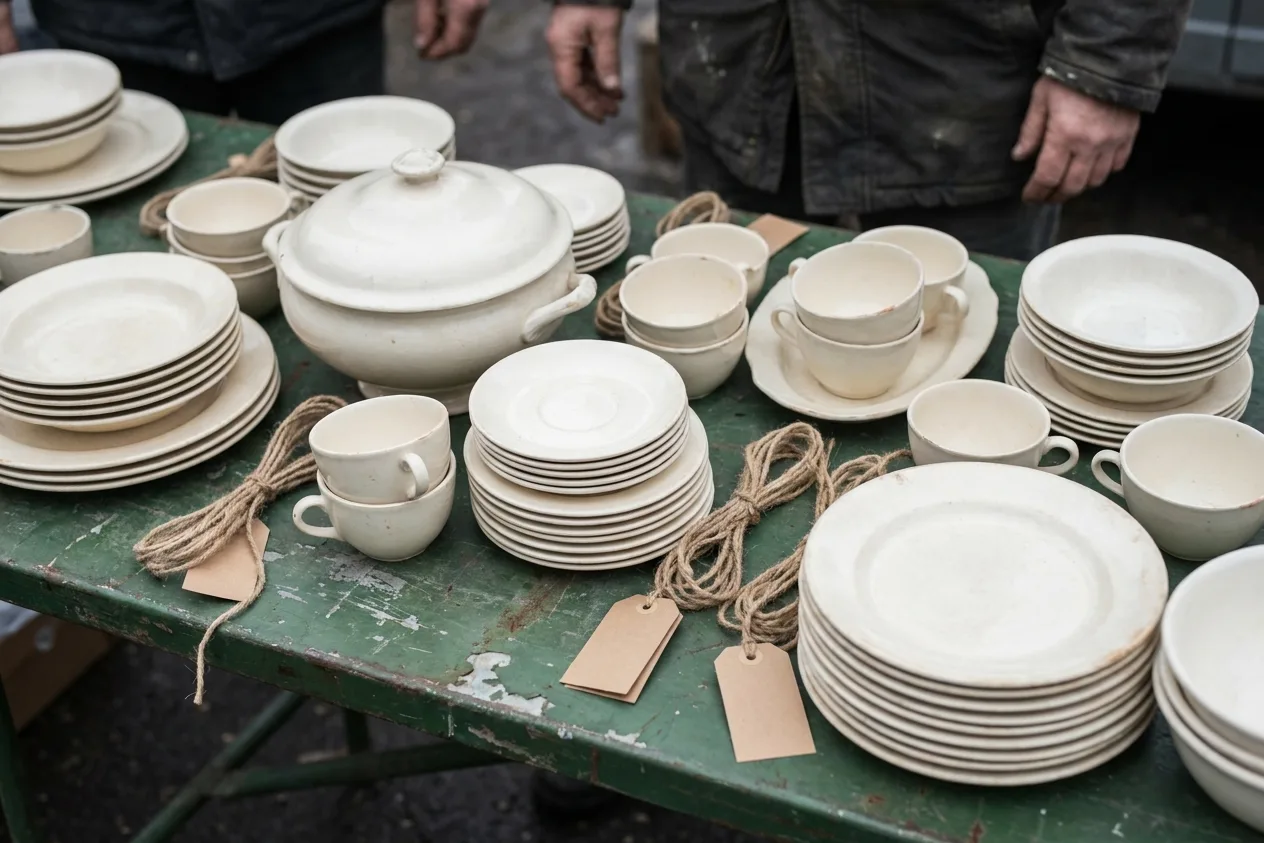
How to price china and porcelain at an estate sale
Every house has the cabinet. Twelve place settings that came out three times a year, wrapped in tissue for four decades, and a family absolutely certain it is the most valuable thing in the room. It is usually not, and telling them so is one of the harder conversations in this job.
That conversation goes much better when you can explain the market rather than just deliver a number. So this page is about what actually moves china prices, how to read a piece in thirty seconds, and how to clear a cabinet without spending your whole Tuesday on it.
What happened to the market
The change is real and it is generational. The dealer Busby Antiques states it directly: younger generations are not registering for formal place settings the way their parents did, and the market has shifted substantially over the last twenty years. Two forces stacked. Formal dining declined, and at the same time an enormous supply of inherited sets arrived on the resale market as one generation downsized. Low demand plus high supply is a price, and it is a low one.
Blue Moon Estate Sales’ 2026 outlook puts large traditional furniture, including formal dining sets, in the declining column, and the china cabinet travels with the dining room it lived in. When the furniture that displays a thing is soft, the thing is soft.
None of that means every plate in the house is worthless. It means the value is concentrated in far fewer pieces than it used to be, and your job is to find those pieces quickly.
Turn it over first
Everything starts with the backstamp. Pick up a plate, turn it over, and read all of it, not just the brand.
- Maker. The name of the factory.
- Pattern name or number. Usually printed under the maker, sometimes just a number.
- Country of origin. A useful dating hint. Marks change when borders and trade rules do.
- Marks that are not printed. An impressed or hand-painted mark rather than a transfer-printed one usually means an older and more carefully made piece.
- Nothing at all. Unmarked is not automatically worthless, but it is a pricing problem, because a buyer who cannot identify a piece will not pay for the possibility.
Maker plus pattern is enough to look a piece up. Busby’s own recommended method for valuing a set is the same one the pricing chapter of our free playbook applies to everything else in the house: check sold listings rather than asking prices, and use a replacement dealer’s pattern database to confirm what you are actually holding. Asking prices tell you what somebody hopes. Sold prices tell you what the market did.
The makers that still carry a market
Busby Antiques publishes per-piece bands for the high end, and reports these as the makers that hold value: Meissen from before 1950 at roughly $200 to $5,000 and above per piece, Royal Copenhagen Flora Danica at $500 to $3,000 and above per piece, Herend at $100 to $1,500 per piece, and Sèvres at $300 to $5,000 and above per piece. Those are one dealer’s read on one market, not a published index, so treat them as an indication of scale rather than a price list. What they tell you reliably is the shape of the market: age, hand craftsmanship and rarity are what is being paid for.
At the other end, the same dealer reports that most Noritake patterns from the 1970s through the 1990s were mass-produced and widely available, and that sets which retailed above $500 now commonly sell for $50 to $100, with mid-range brands showing limited collector demand and incomplete sets losing value substantially.
That gap is the whole lesson. This is not a category with a gentle gradient. It has a small high end priced per piece and a very large ordinary volume priced per stack, and almost nothing in between.
Pricing the ordinary volume without losing a morning
Most of the cabinet is ordinary volume. Handle it like ordinary volume.
- Price the service as one lot for the opening day. A single buyer taking the whole set away is worth more to you and to the family than twelve separate transactions, and it clears a large fragile object out of the house in one movement.
- Pull the serving pieces before you do. Platters, tureens, gravy boats, covered vegetable dishes and lidded sugars are the pieces most often broken and therefore most often replaced. They frequently sell better individually than as part of a set nobody wants.
- Stack and band the rest. Dinner plates in one price, salads and bread plates in another, cups and saucers in a third. Consistent, brisk, and legible from across the room.
- Mark it down on the last day and mean it. A full cabinet on the final afternoon becomes a cleanout expense. The chapter on cleanouts and consignment channels covers where the remainder should go.
Condition rules, and it is stricter than you think
Buyers of tableware are unforgiving, because the point of the object is that it goes on a table. Run a fingernail around every rim and foot. Chips, hairline cracks, crazing that has stained, and the dull gray film that dishwashers leave on gilt all take a piece from saleable to decorative. Gold and platinum banding is particularly vulnerable, and once it has worn or been rubbed by dishwasher detergent it does not come back.
Check under a light, not in the cabinet. Hairlines hide in shadow.
Figurines and decorative porcelain are a different animal
The cabinet often holds figurines as well as dinnerware, and they behave differently. Named factories with a long collecting tradition hold a market where anonymous decorative pieces do not, and condition tolerance is even tighter, because a repaired finger or a reglued limb is visible and permanent. Look for the factory mark, look for a model number, and check every extremity before pricing.
Hand-painted work is worth separating out on sight. Transfer printing produces identical, perfectly registered decoration; hand painting has brush direction, slight asymmetry, and variation between pieces in the same set. That distinction is often the difference between the two ends of the market described above.
When to slow down
Call somebody before the sale opens if you find a mark you cannot identify from a maker that is plainly not mass-market, Asian porcelain of any age, anything with an impressed or hand-painted factory mark, or a large service by one of the European houses. Those are cases where an hour of an expert’s time is cheap next to the downside, which is the same standing rule the playbook applies to pricing the contents generally.
Nothing on this page is an appraisal, and a suggested price on a tag never is either. What you can offer the family is a straight answer, an explanation of why the market is where it is, and a set of prices that actually clears the cabinet. For most houses that is worth considerably more than an optimistic number on a plate that never sells.
Sources
Every figure above is attributed where it appears. These are the places those numbers come from, so you can check them yourself.
Frequently Asked Questions
- Is fine china worth anything now?
- Some of it, and much less of it than families expect. The dealer Busby Antiques puts the shift plainly: younger buyers are not registering for formal place settings the way their parents did, and it reports mid-range brands and most 1970s to 1990s Noritake patterns as having little collector demand, with sets that retailed above five hundred dollars now selling in the fifty to one hundred dollar range. High-end European hand-painted porcelain is a genuinely different market and still trades well.
- How do I identify a china pattern from the backstamp?
- Turn a plate over and read everything on it: maker, pattern name or number, country of origin, and any date or series marks. The maker plus the pattern name is usually enough to find the piece in a replacement dealer database, which is where most operators identify patterns and where you can see what individual pieces are actually listed at.
- Are complete china sets worth more than partial ones?
- More in total, and often less per piece than the family hopes. Completeness matters because a buyer replacing a broken plate wants exactly that plate, but a full twelve-place service is a large, fragile, low-demand object and the pool of buyers for it is small. Serving pieces frequently sell better on their own than as part of the set.
- What china is actually worth pulling out of the cabinet?
- Hand-painted European and Asian porcelain, anything with a mark you do not recognize from a maker that is clearly not mass-market, figurines by named factories, and single serving pieces in demand as replacements. Those get a slow second pass. Everything else gets priced to move on the first pass.
- Should I sell china by the set or by the piece?
- Both, in that order. Price the set for the first day so a single buyer can take the whole problem away. If it does not go, break out the serving pieces and the cups and price the remainder in stacks. A china cabinet that is still full on the last afternoon is a cleanout cost, not an asset.
Run the next house from your phone
TagLot is the back office for estate-sale and senior-move companies — photograph a whole house offline, review the drafted catalog, print QR labels, and hand the family a settlement they can read. Free is one full sale, no card and no countdown, and the money runs on your own Square or cash. Your money lands in your own accounts — never in a TagLot balance.