Updated August 2026
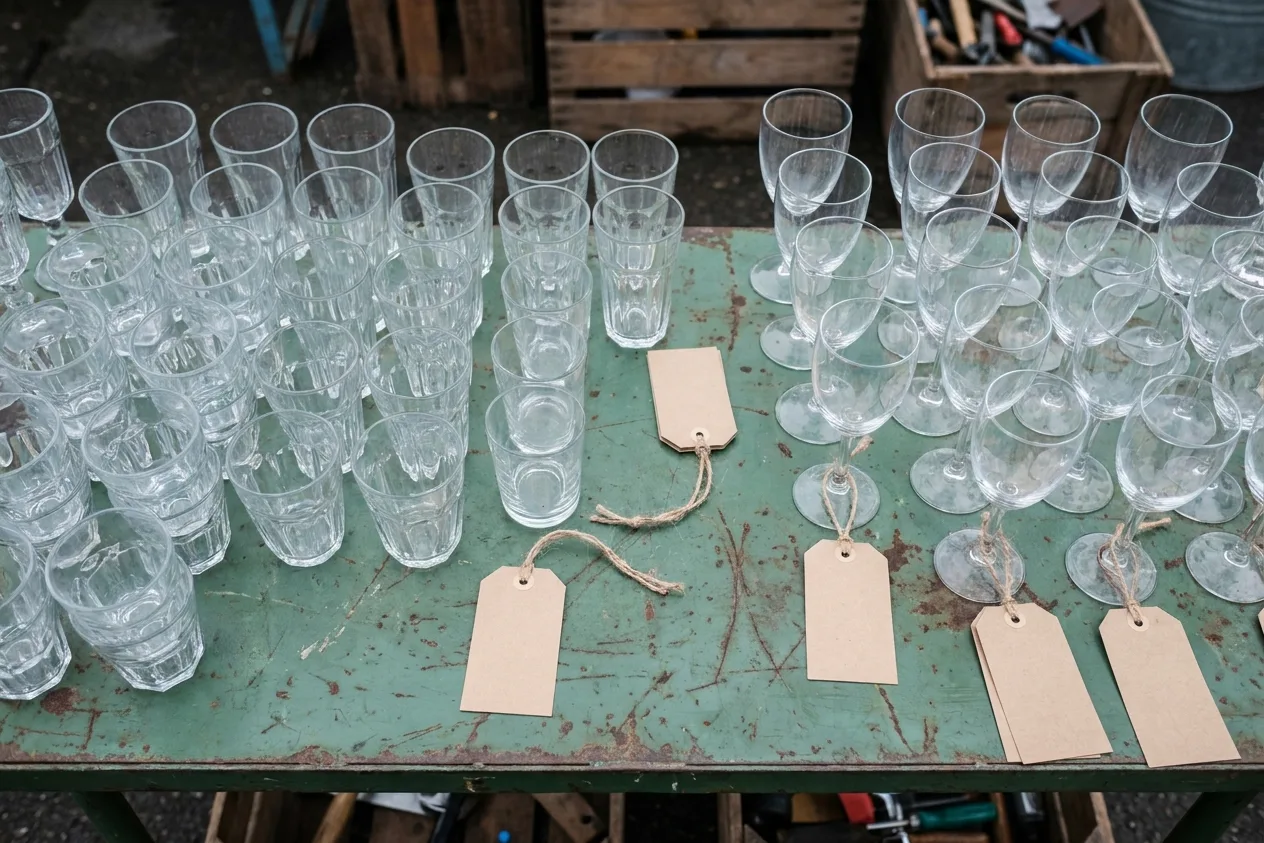
How to price glassware at an estate sale
Glass is the category that punishes speed the most quietly. Two shelves that look identical from the doorway can be a hundred dollars of pressed tumblers and eight hundred dollars of hand-finished stemware, and the difference is invisible until you pick a piece up. Meanwhile there is a great deal of it, it is heavy, it breaks, and it is the last thing anyone wants to still be handling on the final afternoon.
The way through is not to learn patterns. There are thousands of them and no operator learns them all. The way through is to learn the four families, sort the cabinet into them in one pass, and then apply completely different amounts of effort to each.
The four families, and the tells that separate them
Depression glass. The National Depression Glass Association describes it as glassware generally made in the period 1929 to 1939, found in clear or colored translucent colors. Antique Trader dates the era 1929 to 1940 and describes how it moved: distributed as free bonuses with household products such as cereal and soap, or given away at movie theaters. It was cheap when it was new, made in enormous quantity, and it comes in solid pastel pink, green and amber. Makers include Federal Glass, Jeannette, Hazel Atlas and MacBeth-Evans.
Elegant glass. Made in the same years, sold in department stores instead of given away. The NDGA’s own comparison article contrasts the two directly: Depression glass was machine-pressed and mass-produced, “not as clear as fine crystal” and with seams “often raised”, while elegant glass from Cambridge, Fostoria and Heisey “often included significant hand work”, with ground base rims finished by hand, better transparency and less visible seams. This is the tier that is worth your slow pass.
Carnival glass. Pressed glass with an iridescent finish. Antique Trader dates it from the early 1900s to the 1930s and describes the process: molten glass poured into molds, then metallic salts sprayed on and the piece refired. The International Carnival Glass Association describes the same process and makes an identification point that matters, which is that the base color is what you judge by, seen by holding the piece up to the light, not the iridescence lying on top of it. Marigold is the commonest iridescent finish; the association also names smoke gray and peach opal. The classic American makers are Dugan, Fenton, Imperial, Millersburg and Northwood.
Art glass. Studio and factory art glass, signed or unsigned, from paperweights to cased vases. It has nothing in common with the other three except the shelf it sits on, and it is the family most likely to hold a genuinely valuable piece and the one where you are most likely to need help.
The two tests that do most of the sorting
You can separate the bulk from the good in a cabinet with your hands.
Run a finger over the pattern. The NDGA article gives the tell: mold-etched decoration was cut into the mold, so the design sits raised above the surface of the glass, which is the Depression-glass method. Acid-etched decoration, common on elegant glass, is bitten into the surface and feels flush or slightly recessed. Raised means pressed; flush means somebody did work to it.
Run a finger around the foot. A ground and polished base rim, smooth and slightly matte where the pontil or mold mark was taken off, is hand finishing. A rough or seamed foot is not. Together with the pattern test this sorts a cabinet into two piles in about ten minutes, which is the single highest-leverage ten minutes in this category.
Then hold each iridescent piece up to a window. If the glass under the shimmer is dark amethyst, blue or green rather than clear, you are looking at a base color other than the common one, and that piece belongs in the slow pile.
Dating Fenton carnival glass from its mark
Reproduction is a real problem in iridescent glass, and on one major maker it is solved by looking at the base. Carnival Glass Worldwide records the chronology: classic Fenton carnival glass was entirely unmarked, and when Fenton reintroduced carnival glass in 1970 the company deliberately began marking the new output with “Fenton” in script inside an oval cartouche so collectors could tell the difference. The mark then evolved on a decade schedule, with an 8 added inside the oval in the 1980s, a 9 replacing it in the 1990s, a 0 from the 2000s, and “Fenton USA” and “Fenton International” appearing from 2007.
So the rule is asymmetric and worth stating precisely. A Fenton oval mark rules a piece out of the classic period. No mark does not rule it in, because plenty of other makers and plenty of later reproductions carry no mark either. Use it as an elimination test, not a confirmation.
Pricing without a price list
This page deliberately quotes no dollar ranges, and that is a choice rather than an omission. Glassware prices are pattern-specific, color-specific, condition-specific and regionally variable, and the published ranges circulating online for this category could not be traced to any association or first-party source. A printed band would give you false confidence on exactly the pieces where confidence is expensive.
What works instead is the same method the pricing chapter of our free playbook applies everywhere: identify the piece well enough to search for it, then price against sold comparable results rather than asking prices, on the platforms where glass actually trades. Identification is the hard half, and the sorting above is how you do it fast enough to matter.
For the ordinary volume, band it. Two or three prices across the pressed and Depression glass, grouped by form rather than by pattern, on open shelves where buyers can pick things up. Antique Trader’s note that Depression glass is generally less expensive because of the sheer number of pieces produced is the practical reality: you are moving quantity, and the time you save here is the time you spend on the elegant and art glass.
Condition is not a modifier, it is a category
Glass buyers are unusually strict, and for a rational reason: these pieces were made in quantity, so an undamaged example is usually available somewhere. That makes damage a category change rather than a discount.
Check every rim, foot and handle with a fingernail. Look for the flea-bite chips that hide on the underside of a rim, for bruises where a piece has been knocked, and for the permanent cloudy etch that dishwashers leave on old glass, which no amount of washing removes. A damaged piece is decorative glass and should be priced with the decorative glass, on the other side of the room from the collectible shelf.
When to bring somebody in
Art glass, signed pieces, anything cased or cameo, and any large matched set of elegant glass deserve a second opinion before the doors open. So does an unusually deep single-maker collection, which almost always sells better as a collection than dispersed shelf by shelf. The NDGA maintains a working reference library at its museum and publishes pattern material through its journals, and that kind of association reference is where an operator’s own knowledge of this category gets built over time.
None of this is an appraisal. But a cabinet sorted into four families, with the hand-finished tier pulled out and researched and the rest banded and priced to clear, is a cabinet that will be empty on Sunday. That is the outcome the family hired you for, and once you have run a few sales your own record of what glass actually sold for in your market becomes better than any guide. Getting people through the door to buy it is a separate craft, covered in listing platforms and marketing.
Sources
Every figure above is attributed where it appears. These are the places those numbers come from, so you can check them yourself.
- National Depression Glass Association — what Depression glass is, and the association reference library
- National Depression Glass Association — Etched Depression glass vs. Depression glass vs. Elegant glass
- Antique Trader — Glass Act: the differences between carnival and Depression glass
- International Carnival Glass Association — what carnival glass is and how it was made
- Carnival Glass Worldwide — Fenton carnival glass, old and new (the oval mark chronology)
Frequently Asked Questions
- What is the difference between Depression glass and elegant glass?
- Manufacturing, and you can see it. The National Depression Glass Association describes Depression glass as mass-produced machine-pressed ware, generally made between the late 1920s and about 1941, less clear than fine crystal and with seams that are often raised. Elegant glass, from makers such as Cambridge, Fostoria and Heisey, included significant hand work: ground base rims finished by hand, better transparency, and less visible seams. Elegant glass sold at higher prices when new and generally still does.
- How do I tell mold-etched from acid-etched glass?
- Run a finger over the pattern. A mold-etched design was cut into the mold, so the decoration sits raised above the surface of the glass, which is the standard Depression-glass method. Acid-etched decoration, common on elegant glass, is bitten into the surface and feels flush or slightly recessed. It is a two-second test and it sorts the two tiers faster than any pattern book.
- How can I tell old carnival glass from a reproduction?
- On Fenton, the mark dates it. Classic Fenton carnival glass was unmarked; Carnival Glass Worldwide records that when Fenton reintroduced carnival in 1970 it began marking pieces with Fenton in script inside an oval, adding an 8 in the 1980s, a 9 in the 1990s and a 0 from the 2000s. So any Fenton oval mark means a revival piece, not a classic one. Absence of a mark is weaker evidence, since it only rules the revival period out for that maker.
- Is glassware worth pricing individually?
- Only the top tier. Sort the cabinet into elegant and art glass on one side and ordinary pressed and Depression glass on the other, price the first group individually, and band the second into two or three price points. Pricing sixty tumblers one at a time is a morning you do not get back.
- How much does a chip reduce the value of a piece of glass?
- Enough that it changes the pile the piece belongs in. Collectors of pressed and Depression glass buy on condition because the pieces were made in quantity and an undamaged example is usually available, so a chip, a bruised rim, or the cloudy etch that dishwashers leave takes a collectible piece down to decorative money. Check every rim and foot with a fingernail before you tag anything.
Run the next house from your phone
TagLot is the back office for estate-sale and senior-move companies — photograph a whole house offline, review the drafted catalog, print QR labels, and hand the family a settlement they can read. Free is one full sale, no card and no countdown, and the money runs on your own Square or cash. Your money lands in your own accounts — never in a TagLot balance.